
The weekly fantasy football offseason notes article is designed to keep you plugged into my thought process throughout spring and summer. Each week, I'll focus on developments that matter most for fantasy football, with an emphasis on projecting offensive environments before the market fully adjusts.
This week, we'll look at the most impactful statistics from the last season and how they may be misleading for fantasy managers preparing for this season. Be sure to check out the 2026 Rotowire fantasy football projections to see how we think players will perform.
Michael Wilson – Arizona Cardinals
Michael Wilson's late-season surge looks impressive in the box score, but context is everything during the fantasy football offseason. His breakout production was heavily tied to Marvin Harrison missing time. In Harrison's four full absences, Wilson averaged more than 130 receiving yards and nearly 24 PPR points per game, functioning as the clear focal point of the offense.
When Harrison was active, Wilson's production dropped into WR4/WR5 territory. His targets and yardage declined, and he often disappeared in competitive game scripts. Quarterback play also shaped his season. With Kyler Murray early in the year, Wilson was nearly invisible. His strong statistical stretch came with Jacoby Brissett under center, but even that was inflated by extreme garbage-time volume.
Arizona suffered multiple blowout losses late in the season, creating inflated passing numbers across the roster. That type of volume rarely repeats year over year. Wilson is not being drafted like a league winner, which is appropriate. After 60 picks are off the board, he becomes reasonable value, but projecting another late-season spike ignores the situational factors that drove it.
Marvin Harrison – Arizona Cardinals
Marvin Harrison's usage remains one of the more frustrating storylines of the fantasy football offseason. For the second consecutive year, Arizona deployed him primarily as a downfield threat. His 13.1-yard average depth of target confirms the role: vertical routes, low-percentage throws and limited manufactured touches.
The result was volatile weekly production and underwhelming efficiency. His catch rate remained below average, his drop rate was elevated and his target share in the games he played was off last year's pace and far lower than expected for a supposed No. 1 receiver. Even more concerning, his targets declined once Kyler Murray was lost for the season.


Arizona made one of the more notable fantasy football offseason moves by replacing offensive coordinator Drew Petzing with Mike LaFleur, the Rams' OC the last three seasons. That coaching change introduces hope that Harrison's route tree expands into more short and intermediate routes that offer yards-after-catch opportunities. If LaFleur adjusts the role, the ceiling could emerge quickly. Until we see that shift, however, Harrison remains more theoretical upside than reliable projection.
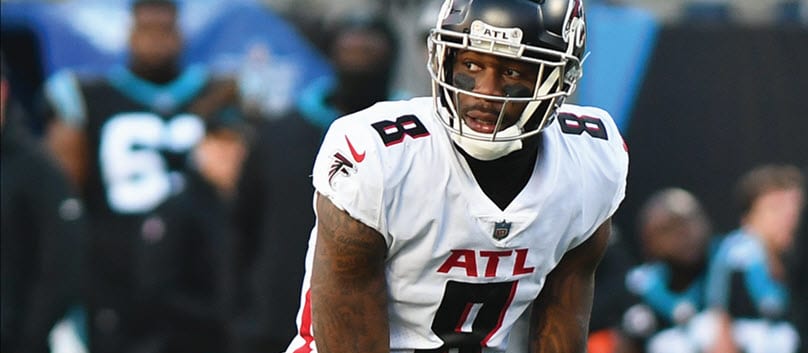
Kyle Pitts – Atlanta Falcons
Kyle Pitts finally delivered a statistical season closer to career expectations, but evaluating it properly is critical for offseason fantasy football rankings. His career highs in receptions and touchdowns suggest a breakout, yet much of his spike aligned with Drake London's absence.
Without London, Pitts operated as the clear centerpiece and posted elite weekly fantasy totals. With London active, his production was far more modest. One massive Week 15 eruption accounted for a disproportionate share of his season output. Removing that outlier paints a picture of a solid TE1, but not a dominant positional advantage.
The late-season chemistry with Kirk Cousins was encouraging, particularly on intermediate routes over the middle. However, Cousins is expected to be gone, and Michael Penix (knee) should be under center. Still, Pitts' overall range of outcomes remains wide. He will be drafted aggressively based on the final stat line, but unless he falls into the lower tier of starting tight ends, there are safer ways to allocate early draft capital.
Drake London – Atlanta Falcons
Drake London continues to profile as one of the most stable assets entering the fantasy football offseason. While his raw totals in 2025 dipped due to five missed games with a knee injury, his per-game efficiency actually improved. On a 17-game pace, his production projected firmly in the WR1 range.
The quarterback transition matters here. With Michael Penix (knee) under center, London maintained strong per-game numbers and showed clear chemistry on intermediate and vertical concepts. Cousins' shorter, conservative tendencies limited London's explosive plays, but Penix was more willing to push the ball downfield.
If Penix is healthy entering 2026, London remains one of the safer early round investments. He wins at all levels, commands consistent targets and maintains red-zone value. After the first 10 picks in drafts, he remains a strong anchor receiver in any format.
Lamar Jackson – Baltimore Ravens
Lamar Jackson's 2025 season is a reminder of how quickly injuries can distort perception during the fantasy football offseason. Through three weeks, he averaged 30 fantasy points per game and looked like the overall QB1. A Week 4 hamstring injury changed everything.
After missing time, Jackson never fully regained his rushing workload. In his final nine games, his rushing average dipped dramatically. That decline alone significantly lowered his weekly ceiling, even though his passing efficiency remained solid.
Because of the injury-marred finish, Jackson might slide slightly in drafts. If that discount pushes him a full round behind Josh Allen, the value becomes difficult to ignore. Nothing in the profile suggests real decline, just a season impacted by health. When evaluating offseason fantasy football strategy, betting on restored rushing upside at a slight discount may be a power move.
Conclusion
As you continue preparing for 2025, make sure to reference the RotoWire fantasy football depth charts to track evolving roles and roster changes as teams finalize their lineups. And don't miss any of my offseason articles — be sure to visit my article page on the RotoWire for weekly updates, strategy insights and early fantasy takes throughout the NFL offseason.